

When employees reduce their working hours or are suddenly unavailable because of childcare gaps, it affects the whole business. The new study "Childcare as a business factor – Swiss SMEs between potential and practice" shows how Swiss SMEs are dealing with this.
For the study, commissioned by Awina and the Mercator Foundation, the research institute Sotomo surveyed 307 managers from Swiss SMEs. The results show what impact childcare responsibilities have on everyday work, what support companies already offer, and what obstacles stand in the way of greater involvement.
Childcare as a business factor: what the study shows
The results show that childcare responsibilities have concrete effects on everyday work for many SMEs:
94% consider work-life balance important for their company.
83% notice effects of childcare responsibilities on their staffing resources.
54% report reduced working hours due to childcare responsibilities.
51% experience short-notice staff absences.
Around one in four SMEs mentions that staff planning becomes more difficult.
This makes childcare as a business factor relevant not only for work organisation but also for securing skilled staff and employee retention.
Read the full study "Childcare as a business factor"
How do Swiss SMEs support their employees today?
Family-friendly working models already exist in many companies. Part-time work is offered by 64 percent of the SMEs surveyed, and flexible working hours by 58 percent. Home office options and time off when a child is sick are also among the measures offered.
Concrete support with childcare, on the other hand, is still rare. Financial contributions towards childcare costs, advisory services, or cooperation with daycares are so far only offered by a few companies.
Even so, there is a clear desire for further steps: 71 percent of those surveyed would like their own company to take measures towards more family-friendly working conditions.
What holds companies back from offering more support?
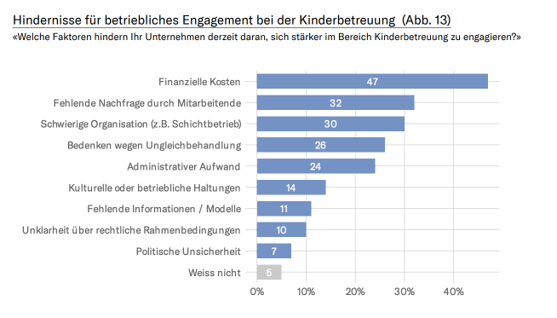
Caption: Obstacles to corporate involvement in childcare. Source: Awina SME study / Sotomo
Financial costs are the biggest hurdle for many SMEs. 47 percent name them as an obstacle to greater involvement. Perceived employee demand also plays a role: 32 percent see this as a hurdle. For 30 percent, organisational complexity is an additional obstacle.
Despite these hurdles, 45 percent would in principle be willing to contribute at least partially to their employees' daycare costs.
Drenushe Shala, CEO and co-founder of Awina, sees this primarily as an implementation gap:
"For us, the study doesn't show resistance, but an implementation gap: willingness is greater than current practice suggests. What many companies lack is a simple, fair, and administratively manageable way to get started."
Another finding stands out here: while 32 percent cite a lack of demand as an obstacle, 44 percent estimate that their employees' interest in greater support is high.
Drenushe Shala puts this apparent contradiction into perspective:
"So maybe it's not the need that's missing, but the expectation that such an offer could even be possible."
For her, the study shows overall that the problem isn't primarily a lack of willingness, but a lack of simple, transparent, and practically feasible ways to get started.
Drenushe Shala also addresses this apparent contradiction in the accompanying interview on the study.
→ Read the interview with Drenushe Shala on the study results
Why are medium-sized SMEs particularly interesting?
Interest in new support models is higher among medium-sized and larger SMEs than among small businesses.
Drenushe Shala therefore sees medium-sized SMEs as a particularly relevant group:
"They often find themselves in exactly that gap: they're big enough to clearly feel the effects of childcare responsibilities through absences, part-time workloads, or recruitment challenges, but too small to build their own comprehensive HR or childcare solutions."
Central, cooperative models could therefore be particularly interesting for these companies. Awina doesn't simply want to offer a ready-made solution, but rather to test together with selected SMEs which kind of support is financially viable, administratively simple, and genuinely helpful for employees.
What does better childcare bring companies?
Better childcare options could also affect working hours. 64 percent of the SMEs surveyed believe that employees could increase their workload if childcare were improved.
According to the SMEs, better childcare provision could also affect work efficiency. 73 percent expect positive effects here, for example through fewer absences or higher productivity.
From the SMEs' perspective, there are various reasons in favour of greater involvement. The most frequently cited, at 55 percent, is employee satisfaction. This is followed by employee retention at 41 percent and fewer absences at 32 percent.
Childcare as a business factor is therefore also relevant for attracting and retaining skilled staff.
How can companies concretely support families?

Not every SME can or wants to set up its own in-house daycare. Support can look different.
A central platform can bring together companies, families, and daycares. Employers, for example, can contribute financially to childcare. Families retain the choice between different daycares. Childcare providers gain access to families and companies without having to organise numerous individual partnerships.
In the study, SMEs were presented with a central platform model for childcare. Around half of the companies showed interest in such a solution.
With the Awina Pass, Awina is pursuing a similar approach: employers, families, and daycares are connected through a central platform.
For Drenushe, this is one possible approach to keeping the administrative effort for companies low while offering families more support at the same time.
At the same time, Drenushe Shala emphasises an important limitation:
"A platform doesn't automatically create new childcare places, though. But it can better connect the fragmented childcare landscape and make it easier for families, daycares, and employers to find each other."
What's needed for the next step?
Many SMEs also see politics and public authorities as responsible. Two-thirds would like to see financial support measures. 61 percent are in favour of tax relief.
Simpler processes and fewer administrative hurdles could further help SMEs become more involved in childcare.
The study provides concrete pointers on where support can start. For us at Awina, it's about making it easier to connect families, daycares, and employers. Together with companies and childcare providers, we want to develop solutions that can be put into practice in everyday working life and make it easier for families to access childcare.
Would you like to find out how Awina can support companies with childcare? Get in touch with us and discover our solutions for employers.